LOCATION
GLBT Historical Society Museum
4127 18th Street
San Francisco, CA 94114
ADMISSION
$10; Free for GLBT Historical Society Members
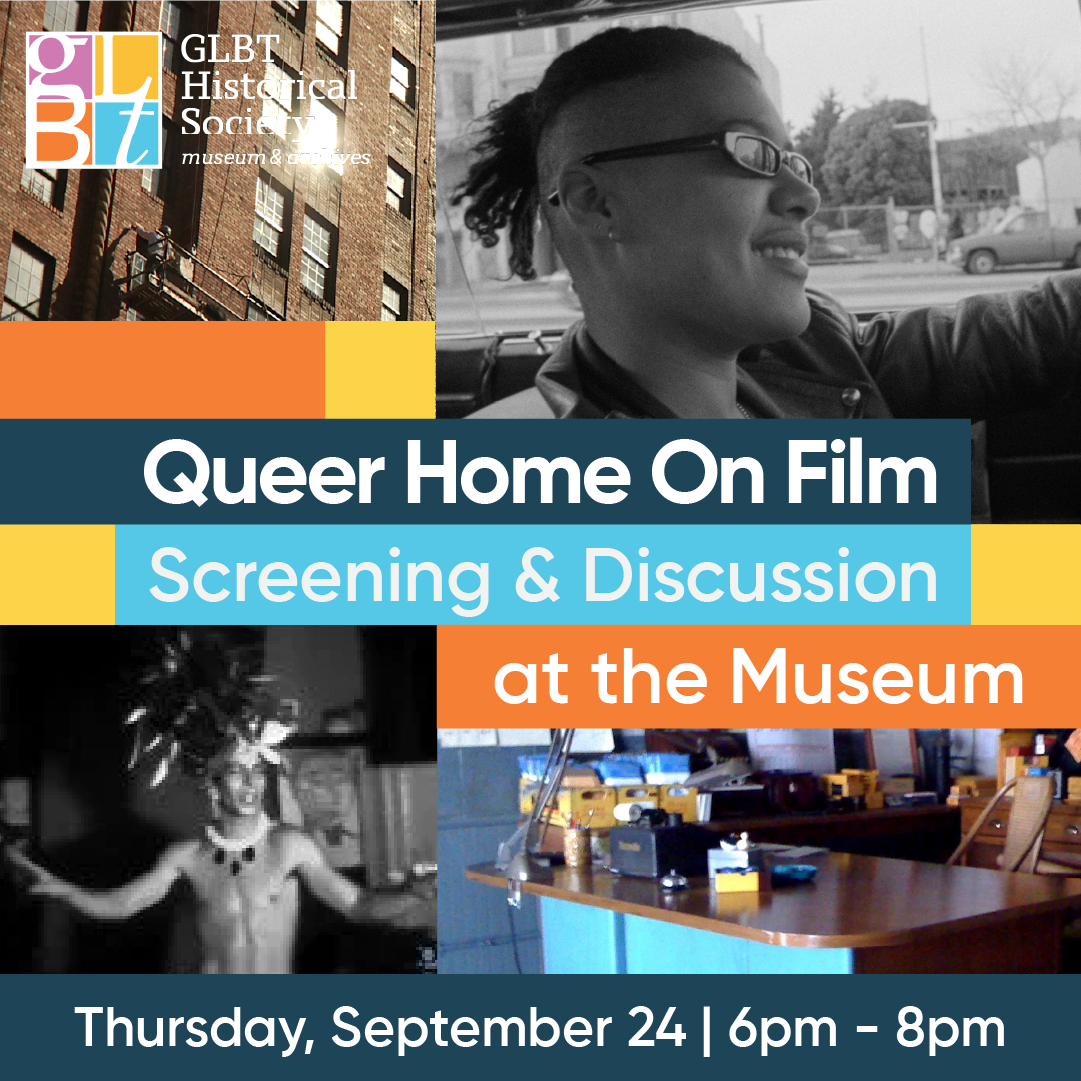
The GLBT Historical Society presents a screening of short films and archival footage that highlight the beauty, grief, joy, and community found in the spaces queer and trans people call home. In conjunction with the current exhibition, Where We Made Room, the program will showcase films and footage centered upon the thesis of queer space and carving out room for ourselves.
The screening will be followed by a discussion between Where We Made Room artist and curator Aleo Landeta and filmmaker Jenni Olson (575 Castro Street) on these themes and their work.
About the Films
Image courtesy of Frameline Distribution
575 Castro St. (2008) - a film by Jenni Olson
7 min.
A powerful elegy from acclaimed queer filmmaker Jenni Olson, 575 Castro St. reveals the play of light and shadow upon the walls of the Castro Camera Store set for Gus Van Sant’s Academy Award-winning film Milk as we hear excerpts from the audio-cassette that Harvey Milk recorded to be played, “in the event of my death by assassination.”
The film features Milk’s now legendary line, “Ya gotta give ‘em hope,” and his eloquent, timely, and timeless denouncement of right-wing anti-LGBTQ hate (calling out Anita Bryant and California Senator John Briggs). The tape was made in November 1977 (after Milk’s election to the San Francisco Board of Supervisors, which made him one of the first openly gay elected officials in the United States). Milk and San Francisco Mayor George Moscone were assassinated by SF Supervisor Dan White one year later, in November 1978. Commissioned by FilmInFocus.com to be showcased online in conjunction with the theatrical release of Milk, 575 Castro St. world premiered at the 2009 Sundance Film Festival and has played at festivals and museums across the globe.
About the filmmaker:
Jenni Olson is an acclaimed queer filmmaker, film historian, and writer. Her contemplative 16mm essay films have screened internationally to awards and acclaim. Among Jenni’s many achievements she has been recognized with the prestigious Special TEDDY Award at the Berlin Film Festival for her decades of work championing LGBTQ film and filmmakers. She is now in post-production on her third feature-length essay film, Tell Me Everything Will Be Okay (2027) and an essayistic memoir of the same name.
Image courtesy of Ira Sachs
Last Address (2009) - a film by Ira Sachs
9 min.
Keith Haring, Robert Mapplethorpe, Norman René, Peter Hujar, Ethyl Eichelberger, Felix Gonzalez-Torres, Cookie Mueller, Klaus Nomi....the list of New York artists who died of AIDS over the last 30 years is countless, and the loss immeasurable. In Last Address, filmmaker Ira Sachs (The Delta, Married Life, and the 2005 Sundance Grand Jury Prize winning Forty Shades of Blue), who first moved to the city himself in 1984, uses images of the exteriors of the houses, apartment buildings, and lofts where these and others were living at the time of their deaths to mark the disappearance of a generation. The elegiac film is both a remembrance of that loss, as well as an evocation of the continued presence of their work in our lives and culture.
About the filmmaker:
Ira Sachs is a NYC-based filmmaker whose feature films include The Man I Love, Peter Hujar’s Day, Passages, Frankie, Little Men, Love is Strange, Keep the Lights On, and Forty Shades of Blue. A Rockefeller, Guggenheim, MacDowell, and Yaddo Fellow, Sachs’s work is held in the permanent collections of New York’s Museum of Modern Art and the Whitney. He is also the Founding Director of Queer|Art, an arts organization built to support mentorship for LGBTQ+ artists and born out of the recognition of a generation of artists and audiences lost to the AIDS crisis.
Image courtesy of Frameline Distribution
Ifé (1993) - a film by Lenn Keller
5 min.
Written, produced and directed by H. Lenn Keller, Ifé chronicles a day in the life of a black French lesbian in San Francisco. This humorous short pays stylistic homage to Jean Luc Godard's 50's film, Breathless. Ifé won Best Short Film at the '94 Madrid International Women's Film Festival, and is distributed by Frameline Films and is also available on a video compilation called Dyke Drama, distributed by Wolfe Video. Ifé premiered at the San Francisco Lesbian & Gay Int'l Film Festival in 1993, and has screened in festivals internationally, including KQED's Living Room Festival, the London Lesbian & Gay Film Festival, Berlin Film Festival, SXSW, and Women in the Director's Chair.
About the filmmaker:
Lenn Keller was a photographer, filmmaker, and activist who played a significant role in documenting and promoting lesbian culture in the United States. In 2014, she founded the Bay Area Lesbian Archives, recognizing the critical need for Bay Area lesbian history to be preserved. Lenn’s vision was a physical and online archives dedicated to the preservation of the richly diverse lesbian history of the Bay Area -- an archives where anyone could access materials about a community that contributed so much to the Bay Area and California. A core group of women who shared Lenn Keller’s vision came together to help make the archives a reality.
Excerpts from the Daniel A. Smith and Queer Blue Light Videotapes Collection
In 2021, the GLBT Historical Society digitized a unique archival collection, the Daniel A. Smith and Queer Blue Light Videotapes, which consists of nearly 100 half-inch videotapes recorded by the Queer Blue Light (QBL) Collective. QBL was a grassroots guerilla project that documented the politics and culture of the local LGBTQ community in the 1970s. While the majority of the tapes document QBL activities, they also contain footage by QBL members of friends relaxing together and living everyday life. For this program, we will screen excerpts from some of our favorite tapes, including footage from a 1980 “Leap Day” dinner party, a home drag runway show, and more.
SPEAKERS
Photo: Jasmine Singh Rosado
Aleo Landeta (they/them) is is a trans and Latine visual artist and educator based in Oakland whose practice spans drawing, painting, installation, and public programming. Their work centers queer joy as liberation, drawing from lived experience and the communities that have held space for them to live authentically. They have been exhibited at MACLA, Bedford Gallery, Berkeley Art Center, and Jonathan Carver Moore, among others, with work held in the permanent collection of the Bakersfield Museum of Art. Recent support includes the SoEx Alternative Exposure Grant (2025), the King Artist Residency (2024), and the Homebody Fellowship at Ma's House & BIPOC Art Studio (2022). Learn More.
Photo: Mettie Ostrowski
Jenni Olson (she/her) is an acclaimed queer filmmaker, film historian, and writer. Her contemplative 16mm essay films have screened internationally to awards and acclaim. Among Jenni’s many achievements she has been recognized with the prestigious Special TEDDY Award at the Berlin Film Festival for her decades of work championing LGBTQ film and filmmakers. She is now in post-production on her third feature-length essay film, Tell Me Everything Will Be Okay (2027) and an essayistic memoir of the same name.
Members Perks
Interested in becoming a member of the GLBT Historical Society? Members enjoy all sorts of perks, including free access to this event. Learn more.